
A FREE MEDITATION RETREAT ON DIFFICULT EMOTIONS
There is a method in the madness.
Most meditation promises to calm you down. This one asks you to do something harder and far more useful: to turn toward your most difficult emotions and find out what they're actually made of. Start with the first retreat, Feel What You Feel, free.
You have probably tried to meditate before.
Maybe it worked for a while. You felt calmer, lighter, a small, quiet bubble of peace. And then life happened: the email you shouldn't have sent, the mood that swallowed a whole day, the old resentment that still feels exactly as raw as it did ten years ago. The calm didn't hold. And somewhere underneath, a familiar verdict: maybe I'm just not disciplined enough. Maybe this isn't for me.
Here is the uncomfortable possibility we want to put to you:
it was never a question of discipline. It was a question of method.
Most of what the West calls mindfulness teaches only the last step of a much older, three-step practice, the part where you sit and try to feel calm. It skips the two steps that make the calm mean anything. So people meditate for years and quietly conclude they're broken. They aren't. They were handed one-third of a method and told it was the whole thing.
There is another way of working with a difficult emotion, one that treats it not as a problem to be soothed away, but as information. As raw energy that, looked at correctly, reveals something true about who you actually are. It is rigorous. It asks you to think, not to believe. The Buddhist tradition it comes from calls it a science of the mind and it means that literally: you are not asked to take a single claim on faith. You test it against your own experience, and you keep only what survives.
That is what Method in Madness teaches. The name comes from Hamlet "though this be madness, yet there is method in't." Our wager is that inside the ordinary madness of a human mind, the craving, the anger, the numbness we all know — there is a method. A structure. And once you can see it, your most difficult emotions stop running your life and start teaching you something.
This free retreat is where it begins.
What you'll get:
Feel What You Feel (Retreat 1, free)
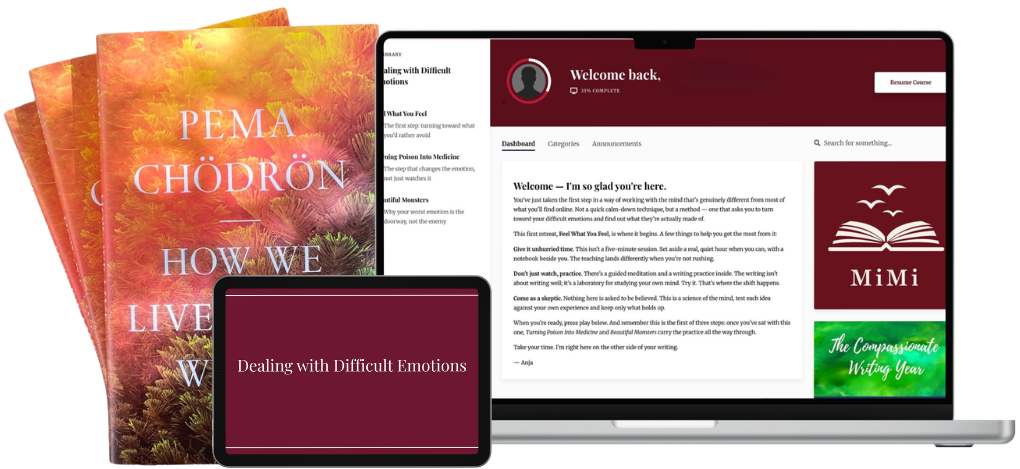
Feel What You Feel is the first of a three-part retreat led by Anja Van Rompaey, built on Pema Chödrön's How We Live Is How We Die. In this session you'll learn:
- Why explaining your feelings doesn't free you from them. The difference between going horizontal, traveling back down the timeline to find the cause in your past and going vertical: deeper into what is actually happening, right now, as you feel it. (One is endless. The other works.)
- What a "difficult emotion" actually is before your mind gets hold of it, the idea of the klesha, and why the raw energy of anger or craving is "not intrinsically bad or good" until you react to it.
- The first step of the method: how to catch an emotion while it's still an ember, instead of when the house is already on fireand how to stay with it embodied, present, and kind, without numbing out or acting it out.
- A guided meditation and a writing practice you can use the same day. (Writing here is not about writing well. It's a laboratory for studying your own mind.)
Who this is for
This will resonate if you're the kind of person who:
- Reads seriously, thinks for a living or for pleasure, and is a little allergic to anything that sounds like a slogan or a promise of easy bliss.
- Has tried meditation apps and secular mindfulness and felt there was something real underneath that they never quite reached.
- Wants the actual philosophy, the why, not just an instruction to "breathe and let go."
- Would rather be challenged than reassured.
Who it's not for: anyone looking for a quick calm-down hack, a guru, or a set of beliefs to adopt. This is study and practice. It rewards attention.